Choosing an authentication mechanism affects the user experience, account protection, access revocation, and complexity of the architecture. JWT is not always more secure than sessions, and sessions are not outdated or non-scalable. The decision depends on the type of client, access duration, revocation requirements, secret management, and infrastructure capabilities.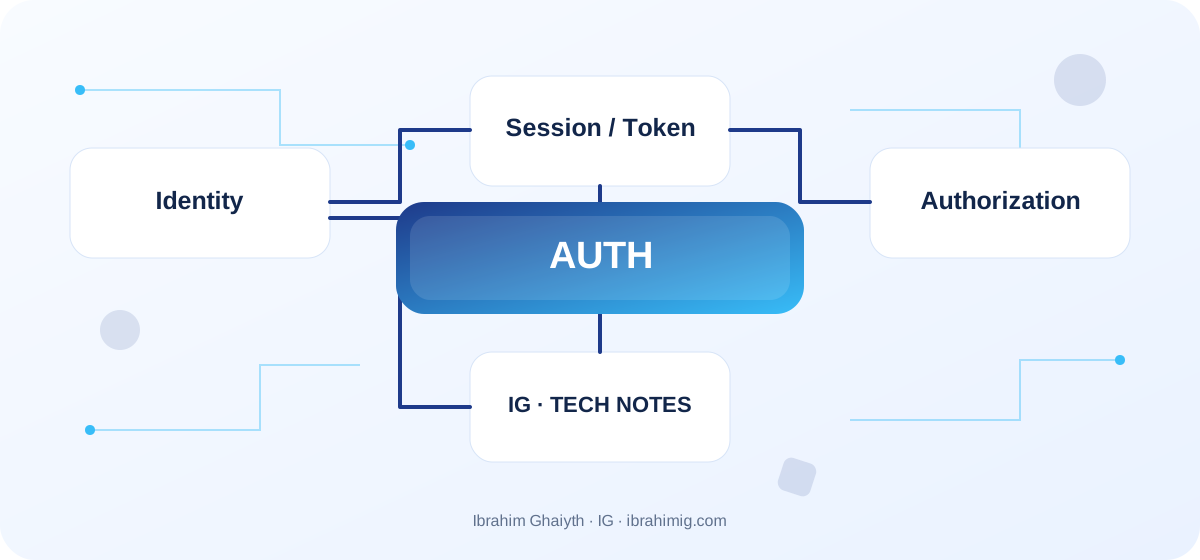
What you will take away from the article
- Separate authentication from authorization.
- Choose a session or token based on the threat model.
- Protect cookies, renewal, and logout.
Authentication is not Authorization
Authentication proves the user's identity, and authorization determines what they can do. A user may be logged in without having the ability to manage users. The server must verify authorization for each operation and resource, especially when the client sends an identifier in the path or request body. Use a clear roles or permissions model and do not rely on hiding buttons in the interface; log important access decisions without storing passwords or tokens in full.
Sessions and Cookies
In the session model, the server maintains the session state or a reference to it, and the browser carries a random identifier in a cookie. The session can be revoked when the user logs out or changes their password. Set properties like HttpOnly, Secure, and SameSite according to your application, renew the session identifier after login or privilege escalation, and set an idle timeout and maximum age. Sessions may require a shared store when there are multiple server instances, but it can be simpler than revoking tokens everywhere.
What does JWT offer?
JWT is a format for carrying signed or protected claims, depending on its type. The signature reveals tampering but does not make the content secret; the content of a normally signed JWT is readable. Verify the signature, algorithm, issuer, audience, and expiration dates, and do not accept a token just because it looks valid. Short-lived access tokens reduce the impact of a leak, while refresh tokens require rotation, protection, and reuse detection according to the design.
Protect Accounts and Choose According to Risk
Do not store passwords in plain text or with reversible encryption; use a password-specific storage algorithm like Argon2id according to current recommendations. Provide rate limiting, protected account recovery, and re-authentication for sensitive operations. Drawing the login, logout, session expiration, and access revocation flow helps you choose sessions or tokens according to the client type and system requirements. Test session expiration, privilege changes, and logout on different devices.
Setting a Web Session Cookie
res.cookie("session", sessionId, {
  httpOnly: true,
  secure: true,
  sameSite: "lax",
  path: "/",
  maxAge: 1000 * 60 * 60 * 8
});

// Requires HTTPS, CSRF protection, and a suitable session policy.
Choose the Right Place for Trust According to the Application Nature
In many web applications with a server, a server-side session with a random identifier inside a secure cookie is a straightforward choice: the server maintains the session state, and the browser carries the identifier only. You must set HttpOnly to prevent JavaScript from reading the cookie, Secure to enforce HTTPS, and SameSite according to the flows, with a suitable expiration and renewal policy.
JWT is not automatically "more secure"; it is a token format that carries signed claims and requires precise verification rules, revocation, expiration, and renewal planning. The choice of storage in localStorage or cookies affects the threat model. The decision depends on trust boundaries, multiple services, revocation needs, and not on the popularity of the technology or the ease of copying an example.
Detailed Case Study: From Symptom to Root Cause
The practical case here is: the login token disappears from the interface after logout but remains valid because the server did not revoke the trust. It is not enough to fix the apparent symptom; you need to draw the data or request path from its beginning to the outcome and find where the discrepancy originated. Start by logging what happened, what was expected to happen, and the step that can be proven by measurement, log, or test. Then change one clear factor and redo the same scenario to verify that the root cause was addressed. If multiple components changed at once, it will be difficult to know which one made the difference.
Link the case outcome to the article's principle: authentication is not authorization, and sessions and cookies. These two concepts determine what should be checked first and what can be postponed. Also, log the cases that were not tested, so that the success of one scenario does not become a claim that the entire system is problem-free.
Authentication, Authorization, and Account Lifecycle
Authentication answers "who is the user?", while authorization answers "what is the user allowed to do?". Separate identity verification from access rules to resources. Do not rely on a role sent by the browser, and do not assume that a correct identifier means its owner has the resource. Put verification on the server for operations that read or modify private data.
Plan for password changes, logout from devices, account disablement, session copying, and account recovery requests. Sessions must be revoked at events that require it and must prevent easy account enumeration in the recovery path. Add MFA when risk is suitable, especially for administrative accounts or highly sensitive data.
From Example to Implementation in a Real Project
Start from the example code presented in the article: "setting a web session cookie". Do not move it literally to production before determining its inputs, outputs, and assumptions. Ask what happens when a value is missing, or unexpected data arrives, or the request is repeated, or external trust is delayed. Then implement a small version inside an independent branch and add a test for the basic case and another for a failure case.
Use these steps as a beginning: draw the login, logout, and access renewal flow. Then determine how access can be revoked when needed. Then set cookies or token verification according to the client. Make each step reviewable, and do not combine project settings and secrets inside an educational example. If your environment differs from the example, document the difference and adjust the implementation based on official documentation rather than copying the solution without understanding.
Common Cookie and Token Mistakes
If a cookie is not sent, check the domain, path, HTTPS, SameSite properties, and browser policy. If a JWT is rejected, verify the signature, issuer, audience, expiration time, and allowed algorithm; do not accept any token just because its form looks correct. Avoid trusting sensitive claims before verifying their source and signature.
If the user logs out but remains able to access, check session revocation on the server, cache, and token duration. Deleting the token from the browser interface does not revoke a stolen copy outside the device. The system needs a plan to revoke sessions or change keys/versions according to the trust model.
Systematic Diagnosis Approach Upon Failure
When the solution does not work, do not start by adding another condition before identifying the failure indicator. Record the input, expected outcome, actual outcome, and message or measurement that supports the conclusion. One of the repeated mistakes in this topic is considering JWT encrypted by default. Treat this point as a hypothesis to be tested, not as a preconceived diagnosis; the problem cause might be in a neighboring layer or in an incorrect assumption during testing.
Divide the system into clear boundaries: inputs, processing, external trust, and outcome. Test each boundary separately as much as possible, then implement an integrated scenario. If you fix the issue, add a test that prevents its return or an operational note that helps detect it early. The goal is to make diagnosis repeatable by another team member, not to keep it tied to the memory of the person who discovered the fault.
Session Protection and Login Flows
Use TLS, set an idle timeout and a maximum session duration according to the service sensitivity, and change the session identifier after login or privilege escalation to reduce the risk of session fixation. Protect change operations from CSRF when relying on cookies that are sent automatically, and do not store long-lived access tokens in places where any page script can read them without studying the risk.
Set a limit on login attempts, and add indicators to detect unusual behavior without collecting unnecessary personal data. Log an event like successful or failed login with a correlation identifier, but do not log sensitive passwords, tokens, or recovery links. Make logout clear, and provide centralized session revocation when an account is compromised.
Advanced Considerations Before Adopting the Solution
Before adopting the solution, consider the trade-offs between security, usability, and complexity. Evaluate the potential risks and benefits of each approach, and choose the one that best fits your application's needs. Consider factors such as the type of clients, the sensitivity of the data, and the potential attack vectors. By carefully evaluating these factors, you can make an informed decision and choose the authentication mechanism that best protects your users and your application.
In a real project, the solution is not evaluated based on the success of the happy case only. Review the behavior under load, failure cases, future changes, and relevant security boundaries. It is crucial here to test the entire session cycle and delegation for each resource, and define an appropriate revocation mechanism before choosing between sessions and tokens. Do not treat these points as a later addendum; design decisions can be difficult to change when data accumulates or multiple clients depend on them.
Define metrics or acceptance tests before merging, and clearly document the solution's boundaries. A solution might be suitable for a small site but may need a queue, cache, or stricter architecture as usage grows. Do not add complexity prematurely without evidence, but do not ignore a clear indication that requirements exceed the simple version. A good decision balances current simplicity with the expected cost of change and maintains system clarity for the team.
Test the Entire Dependency Life Cycle
Do not test only correct login; test logout, session expiration, token expiration, password change, account disablement, and a user attempting to access another user's record. Verify cookie properties from browser tools and response headers.
Write concurrent scenarios such as reusing an expired token or sending a request after revocation. Review that error messages do not reveal whether an account exists in each case, following the product model. Success here is not that the button works, but that identity and authorization rules remain valid during change and failure.
Practical Application and Acceptance Criteria
Try this exercise on a test project or a separate branch: test logout, session expiration, password change, and access to a non-owned resource. Write the expected outcome before implementation, record what actually happened, and then fix the difference if it appears. Also, try a boundary case or intentional failure in a safe manner. Do not use real data or a production system to cause experimental failure.
Consider the task complete when re-test steps are documented, testing proves basic behavior and failure state, there are no secrets or sensitive information in the log, and another developer can understand the reason for the solution. If this is not achieved, what is required is not to add more code directly; rephrase the problem and clarify the assumption that was not correct. This approach makes the article a starting point for technical practice, not just theoretical reading.
Frequently Asked Questions About Sessions and Tokens
Is JWT always a substitute for sessions? No; it has advantages and trade-offs in revocation, storage, and complexity.
Does HttpOnly prevent all XSS? No; it reduces cookie reading from JavaScript but does not prevent script execution or allowed requests.
Does logout delete a stolen JWT copy? Not on its own; an revocation mechanism, short expiration, or rotation is needed depending on the design.
Practical Implementation Plan
- Draw the login and logout flow and access renewal.
- Determine how access can be revoked when needed.
- Set cookies or token verification according to the client.
- Protect passwords and account recovery path.
- Test session expiration, permission change, and logout.
Common Mistakes to Watch Out For
- Assuming JWT is automatically encrypted.
- Ignoring session revocation or refresh token rotation.
- Relying on interface protection instead of server-side authorization.
Conclusion
There is no one-size-fits-all choice. Compare sessions and tokens based on life cycle, revocation, and client type, protect cookies and passwords, and test authorization, expiration, and recovery as core paths.