An API interface is the bond that links the frontend to other applications and the server. If the bond is unclear, every update becomes a risk, and clients start guessing data and errors. Good design is not just about naming paths; it's about defining resources, HTTP semantics, input validation, documentation, and version compatibility.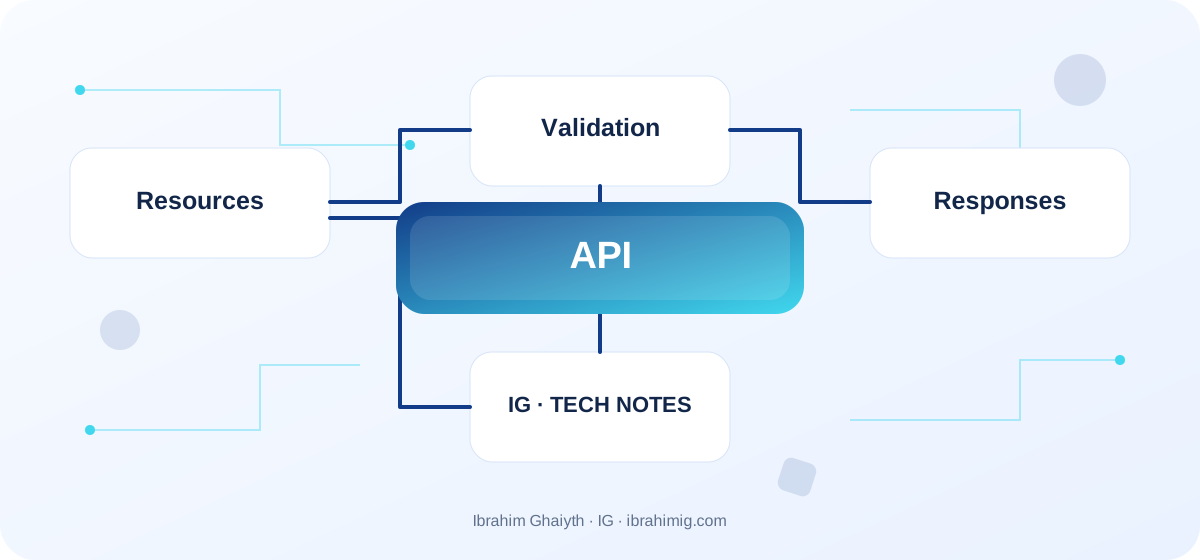
What you will take away from this article
- Modeling paths around resources, not action names.
- Choosing HTTP codes and a consistent error format.
- Documenting the interface and testing it before changing behavior.
Start with resources and their relationships
A path in REST design represents a resource or a collection of resources. Use names like /orders and /orders/42 instead of /createOrder. Design resources according to the concepts of the business domain, not a literal copy of database tables; this separation allows you to restructure the server without breaking clients. Use understandable and plural names for collections where appropriate, and document the relationship between the resource and its subordinate elements.
Use HTTP semantics
GET is usually used for reading, POST for creating a resource or starting a process, PUT for replacement, PATCH for partial modification, and DELETE for deletion. Return appropriate status codes such as 201 when creating, 400 for an invalid request, 401 when missing acceptable authentication, 403 for permission denial, 404 when a resource is missing, and 409 for conflict. Do not put all failure cases inside 200 or 500; the response code is part of the interface and helps the client take the correct action.
Validate inputs and unify errors
Every value coming from the client is untrusted, even if the client is your own application. Validate the type, length, range, and format, then apply business rules and permissions on the server. Make the error structure consistent, including a processable code, an understandable message, and a request ID when needed, without leaking stack trace or internal details. Add pagination and limits to page size, and define sorting and filtering rules to avoid costly requests or ambiguous results.
Document the interface and changes
OpenAPI allows describing paths, operations, inputs, outputs, and authentication in a tool-friendly way. Link documentation to review and testing so it doesn't become an outdated document. Add examples for success and failure, and mention required and optional fields. Removing a field or changing its type can break an existing client; therefore, put a clear versioning policy and support, and contract tests before publishing impactful changes.
Example of error structure and resource path
{
  "error": {
    "code": "VALIDATION_ERROR",
    "message": "One or more fields are invalid.",
    "requestId": "req_8f31"
  }
}

GET /api/v1/orders?limit=20&cursor=...
Design the interface before writing the path
In a request interface, the path /api/v1/orders/123 can be a specific resource, while GET /api/v1/orders?limit=20 is used to fetch a list. Field names, types, and validation rules should be documented; the client needs to know if total is a decimal number, if the status is one of known values, and what happens if the identifier is not found.
Validation error should clarify which field needs adjustment without revealing database details or stack trace. Use a consistent response shape containing a safe code, an understandable message, and a request ID for internal diagnostics. When creating a resource, return the appropriate status and the resource ID or access link, instead of returning 200 OK with a generic message that hides the nature of the operation.
Detailed case study: from symptom to root cause
The practical case here is: a client resends a creation request after a disconnection, resulting in a duplicate record and the interface result differing from the database. It's not enough to fix the apparent symptom; we need to draw the data path or request from its beginning to the outcome, and identify where the difference originated. Start by logging what happened, what was expected to happen, and the step that can be proven by measurement, log, or test. Then change one clear factor and redo the scenario to verify that the root cause is addressed. If several components changed at once, it will be hard to know which one made the difference.
Link the case outcome to the article's principle: start with resources and their relationships, and use HTTP semantics. These two concepts define what should be checked first and what can be postponed. Also, log untested cases so that the success of one scenario doesn't become a claim that the whole system is problem-free.
Large pages and safe repetition
Paging results using limit and offset is easy to understand, but it can become expensive when the client exceeds a large number of rows, and results may change between requests if new data is added. A cursor indicator based on a stable order like creation date and unique ID can provide more stable navigation, but it needs a clear contract for the client.
Also, think about repeating requests. If a connection is broken after executing a payment or creation operation, the client may resend the request because it didn't receive the response. Read operations are generally safe for repetition, but operations that create a side effect need a design that ensures the operation is not executed twice, such as a stored idempotency key verified on the server.
From example to implementation in a real project
Start from the example code presented in the article: «Example of error structure and resource path». Do not move it literally to production before defining its inputs, outputs, and assumptions. Ask what happens when a value is missing, or unexpected data arrives, or a request is repeated, or an external dependency is delayed. Then implement a small version inside an independent branch and add a test for the basic case and another for a failure case.
Use these steps as a beginning: draw resources and relationships before writing paths. Then define the meaning of each HTTP method and response code. Then validate inputs and permissions on the server. Make each step reviewable, and do not combine real project settings and secrets inside an example tutorial. If your environment differs from the example, document the difference and adjust the implementation based on official documentation rather than copying the solution without understanding.
Diagnosing API errors instead of hiding them
When a client reports an error, collect the HTTP code, request ID, time of occurrence, and a data-stripped path. Do not rely solely on the text message as it may change between versions. Distinguish between user input error, permission failure, missing resource, rate limit, and internal error. Each type has an appropriate response and different behavior in the interface.
If the response is slow, divide the time between input validation, database, and external services. Add timeouts for remote connections and avoid random retries that double the load. If the problem is from the client, returning it without changing inputs won't solve it; temporary errors can be retried within clear limits.
Systematic diagnosis approach upon failure
When a solution doesn't work, don't start by adding another condition before identifying the failure indicator. Record the input, expected outcome, actual outcome, and the message or measurement that supports the conclusion. One of the repeated mistakes in this topic is naming paths with repetitive verbs like /getUsers. Treat this point as a hypothesis for examination, not a preconceived diagnosis; the problem cause might be in an adjacent layer or in an incorrect assumption during testing.
Divide the system into clear boundaries: inputs, processing, external dependency, and outcome. Test each boundary as much as possible, then implement an integrated scenario. If you fix the issue, add a test that prevents its return or an operational note that helps in early detection. The goal is to make diagnosis repeatable by another team member, not to keep it linked to the memory of the person who discovered the fault.
Versions, security, and documentation
Use a clear version when changes break the interface, but do not add a new version number for every small adjustment that doesn't affect compatibility. Document request and response fields, possible errors, authentication, rate limits, and pagination mechanism. Make documentation part of code review so it doesn't lag behind implementation.
Verify access permission for each resource on the server; knowing a request ID doesn't mean allowing its read or modification. Do not trust user IDs or roles sent from the browser. Remove secrets from logs, and set limits to body size and pages. Do not return internal database error messages to the client.
Advanced considerations before adopting a solution
Before adopting a solution, consider the trade-offs between different approaches and the potential impact on your system. Evaluate the solution based on factors such as scalability, maintainability, and security. Consider the potential risks and benefits of each approach and choose the one that best fits your needs. Additionally, consider the potential impact on your users and the overall user experience. By carefully evaluating the pros and cons of each approach, you can make an informed decision and choose the best solution for your system.
In a real project, the solution is not evaluated based on the success of the happy case only. Review the behavior under load, failure cases, future changes, and relevant security boundaries. It is important here to document HTTP cases, fields, and pagination limits, and make modification processes safe for repetition where the nature of the process requires it. Do not treat these points as a later addendum; a design decision may be difficult to change when data accumulates or multiple clients depend on it.
Define metrics or acceptance tests before merging, and clearly document the solution's limits. The solution may be suitable for a small site but may need a queue or cache or a more stringent structure as usage grows. Do not add unnecessary complexity without evidence, but do not ignore a clear indication that the requirements exceed the simple version. A good decision balances current simplicity with the expected cost of change and maintains system clarity for the team.
Testing the Interface Contract from the Client's Perspective
Write tests to verify HTTP codes, response shape, and boundary cases: missing ID, out-of-range value, empty list, last page, and unauthorized client. Also, test the behavior of repetition when resending a creation request, because success is not measured by one response only.
In review, ask another developer to consume the path based on documentation only. If they have to read the implementation to know what will happen, the contract is not clear enough. This simple test reveals ambiguous fields and undocumented errors before they reach users.
Practical Application and Acceptance Criteria
Try this exercise on a trial project or a separate branch: write an endpoint contract with success and error cases, and test resending a creation request. Write the expected result before implementation, record what actually happened, and then fix the difference if it appears. Also, try a boundary case or intentional failure in a safe manner. Do not use real data or a production system to cause experimental failure.
Consider the task complete when the steps for retrying are documented, the test proves basic behavior and failure case, there are no secrets or sensitive information in the log, and another developer can understand the reason for the solution. If this is not achieved, what is required is not to add more code directly; rephrase the problem and clarify the assumption that was not correct. This approach makes the article a starting point for a technical practice, not just a theoretical reading.
Frequently Asked Questions When Building a REST API
Should I return 200 for every success? No; choose codes that reflect the nature of the operation, such as creating a resource or accepting non-synchronous processing.
Should I use offset or cursor? Choose based on data size and order stability, and document the behavior for the client.
Where do I apply permissions? On the server for each operation and resource, not just by hiding a button in the interface.
Practical Implementation Plan
- Draw resources and relationships before writing paths.
- Define the meaning of each HTTP method and response code.
- Verify inputs and permissions on the server.
- Create an OpenAPI file and real examples.
- Test compatibility before publishing new changes.
Common Mistakes to Watch Out For
- Naming paths with repetitive verbs like
/getUsers. - Returning 200 for a failed operation without a clear contract.
- Leaking internal details in error messages.
Conclusion
A good API contract can be understood, tested, and developed without surprises. Model resources accurately, follow HTTP semantics, unify errors, document the contract, and consider compatibility an ongoing responsibility.